


Introduction
Extensive research has been done with the Hispanic/Latino population in relation to mental health and poverty. In light of the information provided by researchers, Xinia Arana and I worked in conjunction to facilitate a group of 15 Hispanic/Latino high school students to address said issues. The project was titled Generational Trauma Groups and was conducted at Morris Innovative High School in Dalton, Georgia. The project was intended to last for 10 weeks, but due to COVID-19, it only lasted five weeks.
Social Issue being addressed
The social issues being addressed throughout this project are the different challenges faced by the Hispanic/Latino population and the generational trauma formed as a result. As of July 1, 2018, 50.8% of the Dalton, Georgia’s population was Hispanic or Latino (United States Census Bureau, 2018). Knowing what challenges this population faces can be extremely beneficial when serving this community. For those who immigrated to the U.S. many challenges, such as poverty, family separation, adjusting to a new culture, and discrimination, have been associated with anxiety, depression, and Post Traumatic Stress Disorder (Ramirez, Gallion, Aguilar, & Dembeck, 2017). Immigrants who came without legal approval also face mental health issues. In one of Garcini’s earlier articles, he pointed out that the obstacles undocumented immigrants face make them more susceptible to mental health disorders (as cited in Garcini et al., 2017). Mental health, especially among this population, needs to be taken seriously. Suicide and suicidal thoughts are more prevalent among Latino adolescents, with the rates doubling among Latina adolescents (U.S. Department of Health and Human Services, 2016).
Immigrants are paid unreasonably low wages. Not enough to provide for basic needs. o Increases their probability of living in poverty (Kamal & Killian, 2015). Hispanic immigrants usually live in areas dominated by poverty and violence (NeMoyer, Rodriguez, & Alvarez, 2019). Communities that house vast majority immigrants are usually low-income which poses a greater risk for experiencing traumatic events (Garcini et al., 2017).
Out 248 undocumented immigrants: ⅓ had endured at least six or more types of traumatic events. 82.7% reported a history of trauma. 47.0% met the criteria for clinically significant psychological distress (Garcini et al., 2017). Out of 246 undocumented immigrants: 52% met criteria for clinically. significant psychological distress (Garcini et al., 2018).
Women are more prone to suffer from depression and anxiety (NeMoyer, 2019). Unaccompanied minors are also at high risk. The National Longitudinal Study of Adolescent to Adult Health described levels of depressive symptoms among 755 Mexicans, 182 Cubans, 219 Puerto Ricans, and 289 other Latinos. (Estrada-Martínez, 2019).
The original idea for this project stemmed from my Administration 1 course. Throughout this course my group members and I studied the different aspects and effects of generational trauma. Additionally, interning at Morris Innovative High School motivated me to carry out these groups and my co-facilitator and I decided to carry out the groups beyond our course, and Morris Innovated High School sponsored and supported us.
Interventions designed
The mission of this project was to alleviate generational trauma among high school student attending Morris Innovative High School.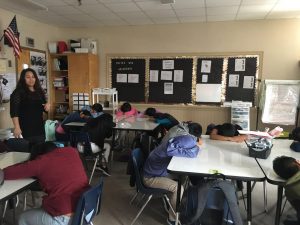
The goal of this project was to help students learn coping mechanisms and other healthy alternatives to deal with generational trauma. These goals were created based on research done for this project.
The intervention tools were the 10 lesson plans created by my co-facilitator and I. These lesson plans addressed school, poverty, stress, anxiety and depression, among other mental health issues.
The Psychosocial Development Theory was the theoretical perspective used during the development of these lessons and group by using the internal and external factors that affect an individual’s mental health and well-being.
Results Achieved
The individuals served were Hispanic/Latino high school students at Morris Innovative High School. Unfortunately, due to COVID-19, we were unable to measure the results of the groups. We conducted a pre-assessment, but did not have the opportunity to conduct the post-assessment and evaluation. However, we did notice a change in rapport, openness, and participation as the group progressed.
While we did not receive any official form of recognition, the student’s teacher expressed to us that they would anxiously wait for it to be time for the group. This was an indicator that they enjoyed our time together and learned from the lessons we provided. My supervisor, John Allen, also reviewed the lesson plans and provided wonderful verbal feedback.
Conclusions
The group was very enjoyable and I believe it was very beneficial for those who participated. However, there are still limitations, improvements, and unexpected outcomes that should be reviewed.
Two limitations while facilitating these groups were not being able to have the students evaluate the group and only meeting once a week. Not receiving feedback at the end, hindered us from being able to improve the group sessions, and only meeting once a week felt like there wasn’t enough time to go into depth with such a large group.
In future, I would recommend having a group of 10 or less students so the time can be appropriately divided among each student. I would also suggest being more strategic with recruiting if possible. We were just given a classroom of students, and therefore did not have the opportunity to recruit.
Some unexpected outcomes were the students actually retaining the information previously provided, the students being so open to discuss certain topics, and having an easy time building rapport with mostly all the student.
Competencies
Competency 1: Demonstrate Ethical and Professional Behavior
- This competency was met by conducting myself in an ethical and professional manner throughout the planning process and implementation of the groups.
Competency 2: Engage in Diversity and Difference in Practice
- This competency was met by engaging with students and conducting groups that focused on generational trauma among the Hispanic/Latino population.
Competency 3: Advance Human Rights and Social, Economic, and Environmental Justice
- This competency was met by creating a flyer that discusses the challenges faced by this population.
Competency 4: Engage in practice-informed research and research informed practice
- This competency was met by creating a presentation based on research focused on different challenges surrounding the Hispanic/Latino population.
Competency 5: Engage in Policy Practice
- This competency was met by discussing the importance of this program with school administrators and advocating for why it should be approved and implemented.
Competency 6: Engage with Individuals, Families, Groups, Organizations, and Communities
- This competency was met by engaging with students during the groups, inviting administration to observe, and communicating with professors and administrators.
Competency 7: Assess Individuals, Families, Groups, Organizations, and Communities
- This competency was met by creating a Pre and Post assessment to assess the students and their knowledge.
Competency 8: Intervene with Individuals, Families, Groups, and Communities
- This competency was met by providing intervention through the implementation of the program and the lesson plans which included strategies the students could implement in their daily lives.
Competency 9: Evaluate Practice with Individuals, Families, Groups, Organizations, and Communities
- This competency was met by creating an Evaluation Form to gauge the effectiveness of the program.