
(2.1) Recognize and discuss personal values in a way that allows professional values to guide practice.
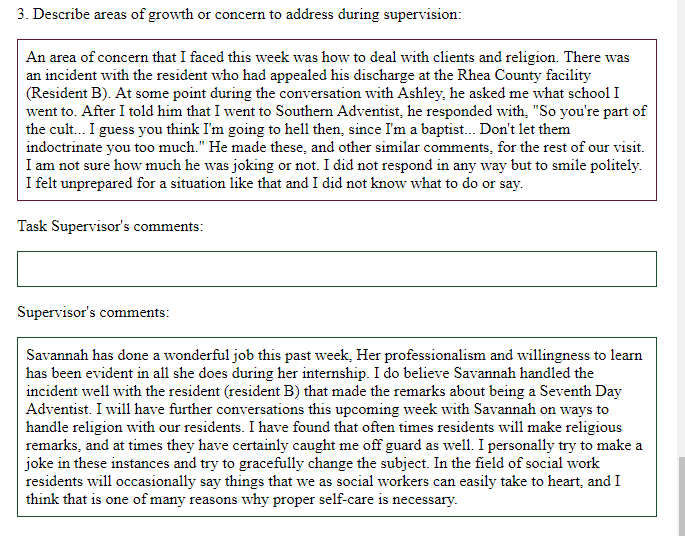
Field: I demonstrated this practice behavior when I appropriately handled situation where a resident criticized my religious beliefs. I described the experience in one of my journals and discussed the issue of handling personal criticism by residents during supervision.
Class: For my Social Welfare (SOCW 211) class, I wrote a paper on the importance of the NASW Code of Ethics and the values found within it. My paper focused on the importance of the ethical principle of “dignity and worth of a person.”
(2.2) Make ethical decisions by applying standards of NASW Code of Ethics and, as applicable, of the International Federation of SW/International Assoc. of Schools of SW Ethics in Social Work, Statement of Principles.
Field: I read the Law Code of Ethics and the Social Work Code of Ethics and compared them for similarities and differences.
Class: For my Interviewing skills (SOCW 213) class, I wrote a skills and values paper that discusses my personal values in relation to the NASW Code of Ethics and my future social work practice.
(2.3) Tolerate ambiguity in resolving ethical conflicts.
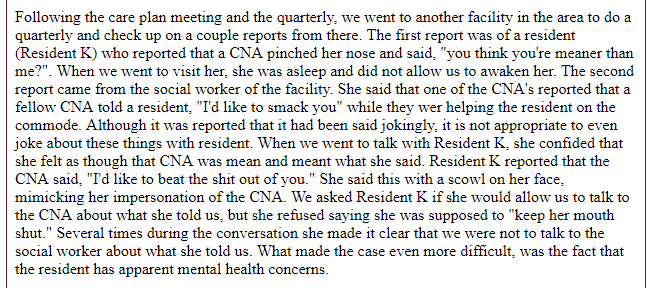
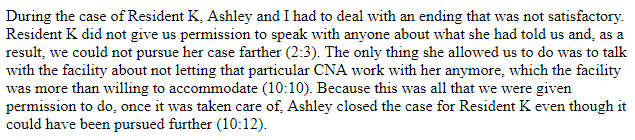
Field: I demonstrated this practice behavior during the case of Resident K. She did not want us to speak with anyone about what she had told us about the abuse allegations. Even though we would have liked to tell the social worker at the facility what Resident K said, we did not because we did not have permission. We could only do what the resident asked, and ended up closing the case because we could not pursue it any farther.
Class: I wrote a literature review paper during SOCW 311 that discusses the different viewpoints surrounding sex-trafficking and prostitution. This paper highlights the need for tolerating ambiguity, because viewpoints are subjective matters of opinion and it cannot be determined what is the wrong or right viewpoint.
(2.4) Apply strategies of ethical reasoning to arrive at principled decisions.
Field: This practice behavior was demonstrated on November 7, 2017 during a care plan meeting at a facility. When a resident’s rights (Resident N) were conflicting with the wishes of the facility, the Ombudsman and I attended a care plan meeting to negotiate a intervention strategies between the resident and the facility that satisfied the facility, but also protected Resident N’s rights.


Class: During the policy brief completed for SOCW 434, we connected our chosen policy with ethical principles found in the NASW Code of Ethics to reinforce our decision to advocate for that bill.