Competency #1: Demonstrate Ethical and Professional Behavior
Practice Behaviors:
1.1 – Make ethical decisions by applying the standards of the NASW Code of Ethics, relevant laws and regulations, models for ethical decision-making, ethical conduct of research, and additional codes of ethics as appropriate to context.
1.2 – Use reflection and self-regulation to manage personal values and maintain professionalism in practice situations.
1.3 – Demonstrate professional demeanor in behavior; appearance; and oral, written, and electronic communication.
1.4 – Use technology ethically and appropriately to facilitate practice outcomes.
1.5 – Use supervision and consultation to guide professional judgment and behavior.
As a social worker, maintaining professional behavior and abiding by ethical standards is extremely important not only as working professionals but to the outcomes of our clients. Growing these skills is an ongoing process. One can become complacent and slip into too comfortable of a role in the workplace. I plan to be intentional and hold myself accountable to the standards set forth by the NASW and my future agency, as I have at my practicum and at Southern Adventist University.

Evidence:
Evidence 1 (Field) –
As a BSW candidate, I have been able to demonstrate ethical and professional behavior through my field placement by having a schedule in which I follow determined by myself and my field instructor. I have shown my professional behavior through my email correspondence and through dressing according to the Red Cross dress code (business casual). As a professional, I have had situations where I have had to take responsibility for certain circumstances. As coordinator of the Pillowcase Project, we have had a few issues with the delivery of supplies in a timely fashion for our scheduled presentations. I, unfortunately, had to cancel a presentation at the last minute, because we simply did not have enough required supplies for all the students to participate. Due to the school being very upset, and understandingly so, I reached out to the head of the disbursement of supplies to problem solve and possibly improve the process.

Evidence 2 (Academic) –
While taking classes in the BSW program at Southern Adventist University, I was required to take a course on professionalism called Networking and Professional Development. Part of this course was to determine our values when it comes to the workplace so that we can be as prepared as possible when entering the professional realm. This project was called The Flower. On it, there are five petals or categories of focus: preferred kinds of people to work with, favorite working conditions, favorite transferrable skills, what we hope to leave behind, and fields of interest. The flower also identifies my Holland Code (personality type).
Evidence 3 (Additional) –
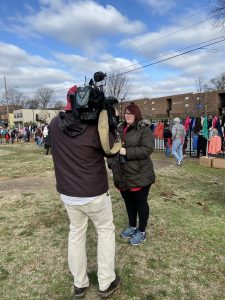
In my role as Social Work Club Community Service Coordinator, I have had to be very professional. Recently there was a large event that was for the population of people experiencing homelessness. I maintained contact with all parties involved and managed to help serve over 140 clients during the event. I was interviewed by News Channel 9 and because of my affiliation with Southern Adventist University, I removed my jewelry before being videoed. This is per the Southern Adventist dress code, I was trying to be as respectful as possible to the beliefs of Seventh-day Adventists and their practice of not wearing jewelry.
Knowledge Used: In my class Networking and Career Development, I was able to increase my knowledge of professional wardrobe, and professional email correspondence. I also used knowledge from Integrative Seminar I and Junior Practicum Seminar to better know how to identify and deal with ethical dilemmas.
Skills Used: This competency required me to use skills that I have gained throughout my life and many experiences. I demonstrate timeliness, time-management, organization, effective and proficient communication both written and orally, and maintain integrity with everything I do. If I make a mistake, I take ownership of it and move forward as best I can.
Values Presented: While demonstrating this competency I have displayed the social work values of integrity, dignity, and worth of the person, and competence. When working as a professional, it is important to never work outside of what you are competent in doing as it could harm your clients or yourself. Through all of my interactions with supervisors, coworkers, and clients I have treated others with respect and remember they are human beings first, and foremost. I have always worked with integrity and owned up to my mistakes along to create a good rapport with others I work with and clients.
Cognitive Process Used: In fulfilling this competency, I have performed the cognitive processes of analyzing and evaluating. I have had to question (analyze) certain situations to determine and evaluate if they were ethically right or wrong.
Affective Processes Used: The affective processes that I have demonstrated in this competency are characterization and valuing. I have been able to choose (organizational) how to handle ethical dilemmas that have come across me. I have also been able to exemplify (characterization) what it means to have professional time-management, integrity, and organizational skills.
Theoretical Foundation: I have drawn from self-monitoring behavior theory while growing my professional persona. It is important to me for others to see me as competent and honest. When mistakes are made, it is more important to me, to be honest than to be seen as failing because it is the professional and adult thing to do.