Competency #3: Advance Human Rights, and Social, Economic, and Environmental Justice
3.1 – Apply their understanding of social, economic, and environmental justice to advocate for human rights at the individual and system levels.
3.2 – Engage in practices that advance social, economic, and environmental justice.
As a social worker, justice and fair treatment for all individuals are imperative. It is what we strive for, and what we seek to bring our nation to. It is important to remember that all clients may not have the same access to resources. It is our job to bring these systemic inadequacies to light, and right them. I plan to never stop fighting for the equality of rights amongst people and to apply the core value of Social Justice to everything I do in my career as a social worker.

Evidence:
Evidence 1 (Field) –
In the field, I have helped the American Red Cross of SETN conquer the barrier of rural county access to resources. I was able to attend, on behalf of the ARC the SVEC Senior Expo that brings social service agencies, information, health screenings and more to the rural parts of the state. This particular event was in Pikeville and below is a journal about the experience. (see week one)

Monthly Field Journal October Week One
Evidence 2 (Academic) –
During our Social Welfare in Policy course, we focused on taking action. This action can be as simple as calling a legislator to tell them you disagree with a certain policy or writing to a local newspaper to bring one’s point of view to light. I have below my letter to the editor of the Chattanooga Free Press about the death penalty. I read an article and was quite moved that Tennessee still uses capital punishment. Not only are we creating another set of innocent victims, but we are not honoring the humanity of the individual convicted of the crime.
Evidence 3 (Additional) –
Being active in policy is in our code of ethics as social workers. Because of this, and my passion for furthering my knowledge on processes and issues facing our community, I attended the 3rd Annual Statewide Women in Policy Conference on February 7th. Here I was a scribe on behalf of Southern Adventist University and took part in multiple seminars including Maternal Morbidity: New Models for Prevention, Taking Action No Excuses and Influencing Policy – No Apologies. In order to advance human rights and social justice, we have to be willing to keep learning. We have to continue to grow, hear new ideas and not be afraid to speak up. This is exactly what I did by taking part in this amazing conference.
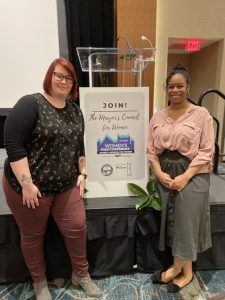
Take Action No Excuses Session Minutes
Knowledge Used: I have used a lot of information from my prior classes while demonstrating this competency. Social Welfare as an Institution is a class that I learned about advocacy for the underprivileged in. I use that information to drive my passion for advancing the rights of those forgotten by society.
Skills Used: I have demonstrated many skills while fulfilling this competency. Interpersonal and communication skills have been the most beneficial in being able to work with clients and advocate on their behalf with other agencies and organizations. I have demonstrated active listening and notetaking as well through many of my experiences at practicum along with my attendance at the Women in Policy Conference.
Values Presented: Through this competency, I have honored the social work value of social justice. Being able to help clients that are not necessarily to advocate for themselves and have their needs met, is the responsibility of social workers. I have also demonstrated service, through this competency and connecting my clients to community resources.
Cognitive Process Used: Through the cognitive process of evaluating, I have been able to defend and support clients through advocacy and ensuring they get the resources they are entitled to after their crisis.
Affective Processes Used: As an advocate of my clients, I act on behalf of them to get their needs met. This is a demonstration of the affective process of characterization.
Theoretical Foundation: As a social worker who practices empathy with all of my clients, I draw from the theoretical foundation of Empathy-altruism Hypothesis Theory. This is the idea that if we feel empathy for others, we are more drawn to help them. This relates to me specifically because my empathy for the underprivileged and forgotten is what drew me to social work.