Competency # 4: Engage in Practice-Informed Research and Research-Informed Practice
4.1 – Use practice experience and theory to inform scientific inquiry and research.
4.2 – Apply critical thinking to engage in the analysis of quantitative and qualitative research methods and research findings.
4.3 – Use and translate research evidence to inform and improve practice, policy, and service delivery.
Best practice is a concept known to the social work field. We got these best practices through research. It is our responsibility as social workers not to waste the time of our clients or cause more harm. The way we do that is through studying research, implementing best practices found through research, and continuing research through furthering education.

Evidence:
Evidence 1 (Field) –
I have created a survey that goes into detail about the socioeconomic status and family dynamics of the participants in the Pillowcase Project presentations. It includes questions that will help me understand if a family makeup and socioeconomic status affect the comprehension of materials. This is given to the teachers of the classes that presentations are given to and compared with their quiz answers to determine if there is a correlation between higher scores and higher statuses.
Evidence 2 (Academic) –
In our class, Research Methods, we, in small groups, came up with research questions that interested us and could be connected to our practicum settings. My group’s question was “Does the sexual orientation of adoptive parents affect the academic, behavioral, and emotional outcome of adoptive children?” This is a very controversial and debated topic because of the high number of children awaiting placement and the recent legislation in some states to ban LGBTQ+ couples from adoption. Not only is it our job to focus on the oppression of the homosexual community, but it is our responsibility to understand the reasoning behind the legislation, which we have attempted through our research proposal.
Academic, Behavioral, and Emotional Outcomes of Adopted Children
Evidence 3 (Additional) –
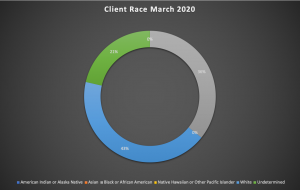
In my field placement, I am a member of the diversity committee for the American Red Cross SETN Chapter. As part of this research, we have compiled information on the demographics of clients and volunteers within our chapter to ensure we are serving everyone. This information will be used in the future to determine the way service delivery happens with clients and to ensure that the scope of the SETN American Red Cross is as far-reaching and inclusive as possible. I have put together a graph of the client demographics for March of 2020. As you can see below, our chapter has predominately white and African American clients.
Knowledge Used: I have learned the importance and relevance of research from my course Research Methods. This has spilled over to my fieldwork at practicum through my Pillowcase Project research and the diversity committee.
Skills Used: I have been able to demonstrate critical thinking and written communication skills throughout the process of researching. I have incorporated this research into my work as the Pillowcase Project Coordinator to use best practices when presenting the material to children. In working through my research project, I was able to demonstrate teamwork.
Values Presented: The most important social work value that I have expressed in this competency is competence. The goal of social work is to help and never hinder or harm our clients. I do this by practicing within my ability and not outside of my abilities. It is okay not to know everything and ask for help.
Cognitive Process Used: I have used the cognitive process of creating by developing a survey to use in my practicum to gain data about how to best deliver the information to the students.
Affective Processes Used: Through the affective process of characterization I am able to act on the information received through the surveys completed by Pillowcase Project recipients and adjust my teaching methods appropriately.
Theoretical Foundation: I have been able to draw from the Intrinsic Motivation Theory to drive my passion for what to spend my time researching. These for me are issues that are personal to me, such as LGBT+ rights, medical intervention rights, and building the resilience of today’s youth.