Competency #5: Engage in Policy Practice
5.1 – Identify social policy at the local, state, and federal level that impacts well-being, service delivery, and access to social services.
5.2 – Assess how social welfare and economic policies impact the delivery of and access to social services.
5.3 – Apply critical thinking to analyze, formulate, and advocate for policies that advance human rights and social, economic, and environmental justice.
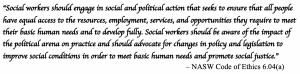
It is our responsibility as social workers to stay up to date on legislation that may affect our clients, advocate for change, and educate our clients on these policies. This is the largest level of impact that our field can have. With the change of one policy, millions of lives can be changed.
Evidence:
Evidence 1 (Field) –
While at the American Red Cross, I have had the honor of working at a disaster shelter to support residents of Nashville after their homes were destroyed by Tornadoes in early March. While at this shelter it came to my attention that some of the Red Cross policies used while sheltering leave the staff and other residents at risk. There was a situation where one resident assaulted one of the shelter volunteers and the police became involved. This resident used a false name and lied on their registration form. The resident ended up having multiple open warrants on him and was arrested. It brought the policy of not requiring residents to show photo I.D. upon registration into question. Amora and I decided we would work on a policy brief to submit to the American Red Cross. This policy would require all residents of Red Cross shelters to present a photo ID and submit to a search through the police database. This policy brief is below.

Evidence 2 (Academic) –
Taking part in the Social Welfare in Policy class, we took a trip to Washington D.C. where we met with staffers to advocate for policies we had researched and wrote policy briefs on. I chose H.R. Bill 4121 “Social Security for Future Generations Act of 2019.” This bill is something that will potentially affect each and every one of us, including all of our clients. It has to do with how the Social Security Trust Funds will continue to be funded and the taxes associated with the Social Security Insurance program. My group and I spent weeks researching this program and the wording of the legislation to make recommendations to improve the bill and get Congressman Fleischmann on board to vote yes.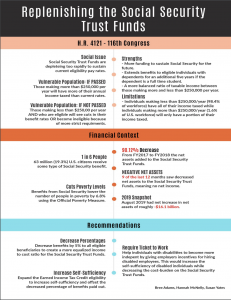
Evidence 3 (Additional) –
While attending the Mayor’s Council for Women’s Statewide Policy Conference in February, I had the privilege of attending free of charge as a scribe on behalf of Southern. During this conference, I sat through three amazing presentations: Take Action No Excuses!, Maternal Morbidity, and Influencing Policy – No Apologies. I was able to learn from some extremely influential women about the horrors of human trafficking and how their persistence and dedication helped to bring the first successful lawsuit against a webpage and bring it down; backpage.com. I have below my notes from one of the sessions I attended.
Influencing Policy – No Apologies

Knowledge Used: I have used knowledge from my course Social Welfare in Policy to guide my advocacy actions and empower others to do so as well. It is our responsibility as social workers to take part in the formulation, and passing of legislation that encourages social justice and the advancement of human rights.
Skills Used: I have had to use my interpersonal skills and written as well as oral communication skills to advocate for policies directly affecting the clients I serve along with my personal experiences. Being able to communicate effectively the purpose and history of legislation, along with the impact on people, our clients is instrumental to the advancement of human rights and social justice.
Values Presented: I have demonstrated the social work values of social justice, and dignity and worth of the person throughout the fulfillment of this competency. Policy change is an ongoing process that social workers are obligated to take part in. Social justice is the foundation of the social work field. By remembering that all people are human beings first, we can honor and respect their dignity and improve the way society views them. Through policy work, it is important to honor the social work value of the importance of human relationships. Without these relationships, we cannot move forward as a society.
Cognitive Process Used: Through the cognitive processes of analyzing and evaluating I have demonstrated the competency above. I have had to judge, criticize and defend certain policies to lawmakers that are in the best interest of my clients and fellow social workers.
Affective Processes Used: The affective process I have used to demonstrate these competencies are organization and characterization. I have had to choose different policies and act on those choices by making presentations for and against the policies.
Theoretical Foundation: Drawing from the conversion theory is a way that social workers, and myself, are able to have hope for the advocacy of policy change. We might be the minority but it is possible to convert the minds of others if the case is presented in a well thought out and prepared way. Conversion theory has four major parts: consistency, confidence, unbiased, resistance. These four properties will help anyone be successful in policy practice.