Competency #9: Evaluate Individuals, Families, Groups, Organizations, and Communities
9.1 – Select and use appropriate methods for the evaluation of outcomes.
9.2 – Apply knowledge of human behavior and the social environment, person-in-environment, and other multidisciplinary theoretical frameworks in the evaluation of outcomes.
9.3 – Critically analyze, monitor, and evaluate intervention and program processes and outcomes.
9.4 – Apply evaluation to improve practice effectiveness at the micro, mezzo, and macro levels.
“Success is not final, failure is not fatal: it is the courage to continue that counts.”
―
How can we know if we are doing our jobs as social workers without evaluation? The short answer is we cannot. Evaluation is a step that must be thoroughly thought out before interactions to ensure that the interventions we decide on are measurable. Different evaluation methods are applicable to different situations, for casework a satisfaction survey may not be enough to determine if their intervention was successful or not. Evaluation of methods allows the use of best practices as they change and mature over time.
Evidence:
Evidence 1 (Field) –
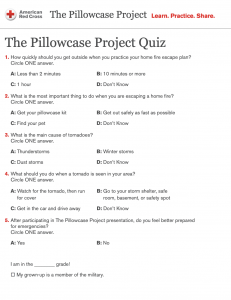
With the pillowcase project, students are taught the material on tornado and home fire emergency preparedness. After the 45-minute class, the students are asked to fill out an anonymous quiz that grades the effectiveness of the presents (that’s me). These quizzes are graded and reported to online to the national Red Cross reporting portal to justify the need for continued funding for the project. Below is the quiz used to evaluate the intervention of the Pillowcase Project.
Evidence 2 (Academic) –
Self-evaluation is something that has been taught to us from the very beginning of our journey here at Southern’s School of Social Work. In order to improve, we have to be self-aware and willing to make changes for the betterment of ourselves and our clients. In Practice with Individuals, we had to do several self-evaluation projects on our skills as interviewers, below is one of my self-evaluation process recordings of a video I did with a pseudo-client.
Evidence 3 (Additional) –
Throughout my field experience, there have many many self-evaluation moments not only with Pillowcase Project but in casework as well. I have successfully scheduled all of the presentations for the year and was unaware that we are not allowed to go above our goal of 850 students. My field instructor was able to correct the situation by requesting excess supplies from another chapter. This evaluation of the situation, regarding having more presentations planned than needed resulted in a long conversation with my field instructor and myself. The journal entry below goes into detail about how many pillowcase presentations had been scheduled and how the project as a whole was going, see week one.
Monthly Field Journal October Week One
Knowledge Used: Through my classes Practice with Families and Groups and Practice with Organizations and Communities, I was able to better understand and apply evaluation techniques in my field placement.
Skills Used: I demonstrated critical thinking throughout the evaluation processes in the fulfillment of this competency. Interpersonal skills were used effectively throughout the process of evaluation and my demonstration of this competency. I had to communicate a lot with my clients and observe behaviors in order to effectively evaluate the interventions put into action.
Values Presented: While meeting this competency I was able to display the social work values of integrity and service. In everything I have done in the field, I have shown my integrity by being honest and forthcoming when it comes to my role and expectations. I have served my clients with respect and helped them to meet their goals, this could not be so without evaluation.
Cognitive Process Used: Throughout the fulfillment of this competency, I have used different cognitive processes. I have had to compare (analyzing) and evaluate (evaluating) the interventions that I have put into place with the clients. I cannot measure (evaluating) the success of a client reaching a goal without evaluation.
Affective Processes Used: This competency has allowed me to use different affective processes as well. I have shown how to revise (characterization) plans that had been put in place during the implementation phased based on the evaluation process. I have also been able to commend (responding) clients throughout the process while attainting SMART goals.
Theoretical Foundation: I have drawn from the valence effect theory while completing this competency. It is important to remain optimistic when working with clients, especially when surrounded by trauma to help them keep moving forward.