Competency Three
Advance Human Rights and Social, Economic, and Environmental Justice
The NASW has a Code of Ethics that we, as social workers, must abide by and strive to follow. Part of that code is to advocate for our clients, to ensure that their human rights are being honored. We must seek out the injustices and work to eradicate them. Currently, at my practicum, I am working on such a project. The project is a large-scale city-wide research project to show the public the extent of the housing crisis and the severity that the added global pandemic of COVID-19 has played here in our community.
Practice Behaviors
3.1: Demonstrate leadership in advocating for human rights, social, economic, and environmental justice
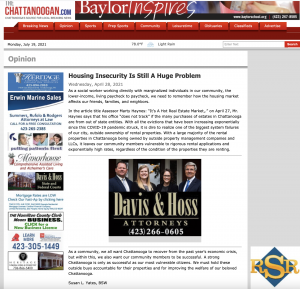
Field Evidence: Finding and maintaining secure housing is a serious issue in the Chattanooga area as of late. I wrote an LOE that was published and this allowed for the public to understand further the crisis of housing instability here in our community. By having outside companies buy real estate in Chattanooga, there is less buy-in for these properties to be maintained and therefore our citizens are suffering. Please view my LOE below that was published in the Chattanoogan.
3.2: Design and implement social action strategies
Academic Evidence: Food insecurity is a problem that many people in our communities struggle with. Through my course of Advanced Administrative Practice: Program Development I, alongside my group, created a plan to help with this injustice that happens every day. Gourmet on a Budget is a program that we developed to teach low-income families to shop for and prepare nutritious food for themselves and their families. This program has the potential to significantly reduce the environmental injustice of food deserts, the economic injustice of affordable groceries, and more. Please review my PowerPoint below explaining the program and the impact it could have.
Skills Used: Through the completion of these practice behaviors I demonstrated professional written and oral communication, leadership, and advocacy with and of my clients.
Knowledge Presented: With the fulfillment of this competency I effectively communicated to advocate for my client’s right to adequate, stable housing and case management services. I practiced proficient written communication and research while drafting the MOU. I drew from my Advanced Social Policy course to be able to effectively advocate on behalf of my client population and work to improve the needs of my client base.
Values Presented: When working with clients and other tasks during my time with the Eviction Prevention Program I demonstrated many social work core values. I was able to demonstrate the importance of human relationships by working on building this MOU and using connections made throughout my practicum. I was able to demonstrate service to future clients of the EPI, as the MOU is not something that was able to be incorporated during my time on the initiative but will be used in future years.
Cognitive Processes: While demonstrating this competency I was able to develop (synthesizing domain) an MOU to benefit future clients of the EPI. This took a lot of research and reading other agencies’ MOU’s to ensure that every detail was covered to the best of my ability ensuring the success of future clients working with CHA and SAU. I also was able to illustrate (application domain) within this MOU the needs the EPI clients are facing and allowed me to advocate for them and the injustices they were experiencing.
Affective Processes: Through examining (organizational domain) the needs of individuals experiencing homelessness after eviction I was able to create (organizational domain) an effective plan for a future partnership that would benefit CHA as well as the clients of the EPI.
Theoretical Foundation: Credibility Theory talks about how when we have evidence it is easier to make a quick and firm decision. Through the creation of this MOU, the evidence was presented to CHA and to SAU regarding the dire state of the housing crisis taking over Chattanooga. This theory helped to create a partnership that will continue to thrive and help those in Chattanooga experiencing homelessness and facing eviction to get back on their feet and become self-sufficient.