



Assess Individuals, Families, Groups, Organizations, and Communities
As a competent social worker, I will apply my knowledge of human behavior to assessing a client’s specific needs. As a professional, I will to strive to gain a deeper understanding of each client’s life experience and history, so that I can accurately and ethically assess client’s to create a treatment plan. I understand that assessments play a key role in helping a client progress in their individual goals. This competency challenges me to explore human behavior theories, trauma theories, and unique disorders that I may encounter while working in my profession. My commitment is to learn from my clients, so that I can best serve them.
Evidence of Practice
While attending Southern Adventist University and studying my MSW, I engaged in a variety of activities that helped me to develop and master this competency.
7.1 – Formulate comprehensive assessments, using a variety of diagnostic classification systems
Course Evidence: During my Psychopathology, Clinical Assessment & Diagnosis Class, we were given case examples of clients to diagnose. Within this class we learned how to properly write a diagnosis for a client (cognitive level: analysis). After reading through the diagnostic manual, we were tasked with watching videos of different pseudo clients who displayed an array of various mental health symptoms. I assessed and diagnosed each client by using the diagnostic manual and decision-making skills. Within the following evidence I watch case example videos and use the DSM-5 to diagnose clients who fit the DSM-5 criteria for Post Traumatic Stress Disorder or Adjustment Disorder. I wrote out the client history, symptoms, and rationale to inform and validate my diagnosis. Please view this evidence here.
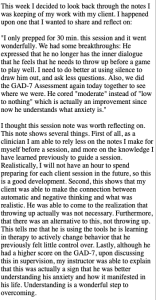
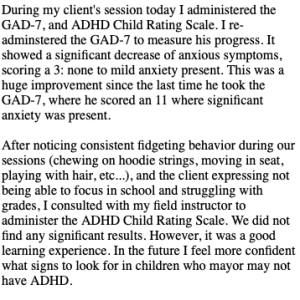
Field Evidence: While working with my telehealth client through the Center for Counseling, I had the opportunity to administer the GAD-7 measurement tool. A the beginning of working with my client I administered the GAD-7 twice, once during our first session, and a second time after we had met several times. The results of his first assessment indicated that he did not have anxiety, however his second assessment informed us that he has a significant amount of anxiety. After discussion with my field instructor, we concluded that his anxiety rating was likely higher the second time because he better understood what anxiety was and how he experienced it, thus he was able to provide a more accurate depiction of the anxiety he was experiencing. The third assessment was performed a few weeks before sessions were terminated. His last score indicated that he had menial to no anxiety. This experience taught me a lot about the importance of helping a client better understand what anxiety is and how it affects your brain and body. You can view my journal entries about these experiences below:
7.2 – Design and implement organizational and/or community assessments
Course Evidence: During my Advanced Administrative Practice class, my assigned group developed a program proposal to provide support and education for teen moms in high school One of the components of this proposal was creating a Needs Assessment plan, and to gather existing data from surrounding schools, clinical and government databases, and hospitals. My group developed two research questions to understand what pregnant teens needed to graduate high school and have an improved quality of life. We used the skills we learned from the CITI training to write a rationale and plan for our intended research. Furthermore, we used our understanding of systems and the social environment to understand the different contributing variables within teens lives. This helped us understand our population so we could know how to perform research. The theoretical framework that influenced the creation of this Needs Assessment plan was Social Exchange Theory. We used this theory by studying the benefits of services within this population. Furthermore, if our services to educate these teen moms would be needed amongst this population. This needs assessment will help our team to understand of teen moms would value the services we were proposing to provide, and if it would be a beneficial relationship. You can view the Needs Assessment Plan here.
Field Evidence: Towards the beginning of my MSW internship with Mpowered, I designed and implemented a Confidential Motherhood Needs Assessment (affective level: valuing). This survey recruited willing participants from the virtual Mpowered instagram community. 30 Mothers virtually participated in this survey. From this we were able to collect data that informed our creation of “The Busy Mom’s guide to the Anxious Brain” online course, and our podcast: “The Motherhood Dilemma”. I reviewed literature that informed the creation of this questionnaire. The survey included open-ended, multiple choice, and Likert scale questions to measure the needs within motherhood. Please see the survey here.