Social workers use ethical, culturally informed, anti-racist, and anti-oppressive approaches in conducting research and building knowledge. Social workers use research to inform their practice decision-making and articulate how their practice experience informs research and evaluation decisions. Social workers critically evaluate and critique current, empirically sound research to inform decisions pertaining to practice, policy, and programs. Social workers understand the inherent bias in research and evaluate design, analysis, and interpretation using an anti-racist and anti-oppressive perspective. Social workers know how to access, critique, and synthesize the current literature to develop appropriate research questions and hypotheses. Social workers demonstrate knowledge and skills regarding qualitative and quantitative research methods and analysis, and they interpret data derived from these methods. Social workers demonstrate knowledge about methods to assess reliability and validity in social work research. Social workers can articulate and share research findings in ways that are usable to a variety of clients and constituencies. Social workers understand the value of evidence derived from interprofessional and diverse research methods, approaches, and sources.
Social workers:
a. Apply research findings to inform and improve practice, policy, and programs; and
b. Identify ethical, culturally informed, anti-racist, and anti-oppressive strategies that address inherent biases for use in quantitative and qualitative research methods to advance the
purposes of social work
My Narrative
Social workers realize the interconnectedness of research in all aspects of social work, because it enhances best practice. Research is crucial to understanding the needs of a population. Social workers integrate integrity in order to ethically engage in research so that it is unbiased.
This competency challenges social workers to apply research so that it can serve clients, but also be attentive to new research findings that may also assist clients. Research must be done meticulously in order to truthfully and effectively implement best practices based on research.
I will remain committed to this competency by keeping well informed about research that is showcased through the NASW and academic journals.
When considering how to apply research in communities, I have learned through social work courses the importance of using research to know the history and needs of a community. Social workers also engage with many individuals, and research fosters growth and understanding for all people. Knowledge is gained through research, and knowledge empowers social workers to know how to effectively advocate for clients.
School Evidence
Research Day Working Draft SOCW-498-Research Methods I–IRB Form, Methods Draft, Self – Care Practices and Perceptions Presentation
This collection of assignments was in preparation for Research Day, where my group will conduct research on the effects of self-care in relation to burnout and academic resilience. In the literature, we did notice that researchers found a link to self-care practice and lower rates of burnout and stress. However, after my team did data analysis, we realized that for our research population, there were not significant relationships between our variables. I chose this competency because this assignment required the knowledge of finding evidence based research, knowing what scales were appropriate for the research variables, and knowing how to formulate a research proposal. Research proposals include the reason for the importance of the topic, the method to conduct and collect research, as well as the process to obtain consent to do so in an ethical manner. This evidence helped me gain practical knowledge and application of the value of integrity, as well as competency in the arena of research. Research requires the analysis of current data, in order to understand the gaps in research study. This guides quantitative and qualitative research in the research project.
I grew in the values of competency and integrity in research. I am someone who is naturally not detail oriented, and this required me to grow my ability to notice details and to strive for competency in research. This was the most challenging evidence yet most rewarding, because I now have a foundation for research skills, and know how to access information more efficiently. I have found that researching best practices in social work has become second nature because I now know what to look for in research.
Field Evidence
Booklet About How Different Religions Perceive Death/Intern Handbook
In my experience in hospice in the Chattanooga area, I encountered people with many different religious beliefs. I created a booklet about the religious perceptions and beliefs surrounding grief for different religions. I wanted to be aware of what they believe death to be, and one way to do so is to know more about their religious affiliation.
This evidence has helped me achieve competency four because it engaged my understanding of the application of research findings in my field. I identified a gap in my knowledge, and used that to guide my research so that I could serve with cultural competency. This was done by finding empirical research that discussed the different ways death is experienced in religions.
This project helped me to relate more to my clients. I aim to be a professional, but also value being personal, and I realize that in the Bible belt in particular, religion is important to many patients. When research is conducted, I believe that biases are addressed because knowledge is increased. This research will inform not just my practice in hospice, but in any field I work in because I will encounter many people with different belief systems.
Evidence Outside of School and Field
Coalition of Black Social Workers (CBSW) Research Project
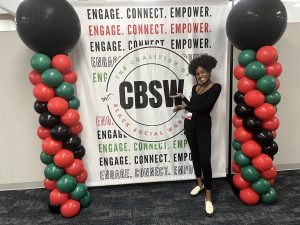
I, along with other social work professors, are conducting research for the CBSW conference. We are studying the effects of self-care on stress for black women. The process for this research project is the submission of an IRB, where I was tasked with finding empirical articles that are related to the research question. I am also tasked with collecting research participants who are willing to be a part of the research. We presented at the annual Coalition of Black Social Workers conference, where we presented on research we found in literature about self-care practice, specifically focusing on sleep, diet, and exercise. The value of integrity will be used during the process to ensure that participants’ identities are secured. I also used the skill of public speaking when presenting at the conference.
I chose this assignment because it incorporates research that is conducted with cultural competency and integrity. This assignment also requires the presentation of the information to help inform communities. I was able to use my skills of communication during this event. It was a fun and memorable experience being able to present to other social work professionals and students about a topic that so many black women struggle to do, self-care.