As a social worker, I recognize that intervention is a continuous and interactive process within social work practice, carried out on behalf of diverse individuals, families, groups, organizations, and communities. I will develop expertise in evidence-informed interventions to effectively support clients in achieving their goals. Understanding the significance of human behavior and the social environment, I will critically evaluate and apply this knowledge to implement effective interventions.
To accomplish this, I will assess and integrate best practices and evidence-based approaches while demonstrating appropriate clinical techniques for a wide range of presenting concerns. This includes utilizing crisis intervention strategies when necessary and collaborating with other professionals to ensure comprehensive and coordinated treatment interventions.
8.1 Implement evidence-based interventions with individuals, families, and/or groups.
Course Evidence: As part of my final project in Advanced Clinical Practice: Individual and Family Interventions, I produced a video demonstrating therapeutic work with a pseudo-client. This assignment highlighted my ability to apply practical knowledge and evidence-based interventions.
To guide the intervention, I utilized Cognitive Behavioral Therapy (CBT); I introduced the client to CBT principles by explaining how thoughts, emotions, and behaviors are interconnected. We worked collaboratively to identify automatic negative thoughts and used cognitive restructuring techniques to reframe them in more constructive ways.
In support of goal setting and measurable progress, the client and I developed SMART goals that addressed their presenting concerns. The intervention maintained a strong person-in-environment perspective, focusing on client self-determination, cultural relevance, and empowerment throughout the process.
This experience deepened my clinical skills and affirmed my commitment to delivering evidence-based, client-centered care. It also prepared me for future clinical roles in school or mental health settings, where I will continue to implement structured interventions that support emotional well-being and long-term success
Field Evidence: During my internship at the Bethlehem Center, I was responsible for creating content outline to guide the implementation of Social-Emotional Learning (SEL) interventions within the Read to Lead Academy, an after-school program serving K–8 students. This outline served as the foundation for a structured, evidence-based SEL curriculum tailored to the needs of students, parents, and educators in the community.
The content outline was designed to reflect the five core SEL competencies—self-awareness, self-management, social awareness, relationship skills, and responsible decision-making—and included measurable objectives, age-appropriate activities, reflection prompts, and facilitation guides. One key section focused on self-awareness, providing structured exercises that helped students identify emotions, explore personal strengths, and understand the impact of their thoughts and behaviors.
Throughout the development process, I applied the person-in-environment perspective, carefully considering the broader social, cultural, and environmental factors affecting students’ emotional development. The activities were intentionally designed to be flexible and culturally responsive, allowing educators and caregivers to adapt them based on the specific needs of the students and their family systems.
The importance of human relationships was woven throughout the curriculum. Each activity emphasized connection, trust-building, and emotional safety—essential components of positive development and resilience. Group-based exercises encouraged peer interaction, while caregiver involvement was embedded through take-home materials that reinforced the same SEL principles outside the classroom.
My use of empathy was central to how I created content. I drew on student stories, classroom observations, and staff feedback to shape interventions that were emotionally relevant and affirming. I prioritized inclusive language, trauma-informed approaches, and real-world scenarios that reflected the lived experiences of the youth we served. This allowed students to feel seen and understood, and helped build their confidence and emotional intelligence.
By developing outlines for content and supporting its implementation, I demonstrated the ability to design and deliver evidence-based interventions that support social-emotional growth and holistic well-being. Through this assignment I was able to engage students, families, and school staff through multi-level interventions grounded in best practices, empathy, and relational social work values.
8.2 Integrate macro level evidence-based strategies with organizations and/or communities.
Course Evidence: As part of my professional development in School Social Work Emphasis I, I successfully completed the Trauma-Informed Resilient Schools training through STARR Commonwealth. This evidence-based training emphasizes the systemic impact of trauma and the need for schools to become safe, supportive, and resilience-building environments for all students and staff. It offered a macro-level perspective on how trauma is not only an individual experience but also shaped by school climate, community context, and institutional practices.
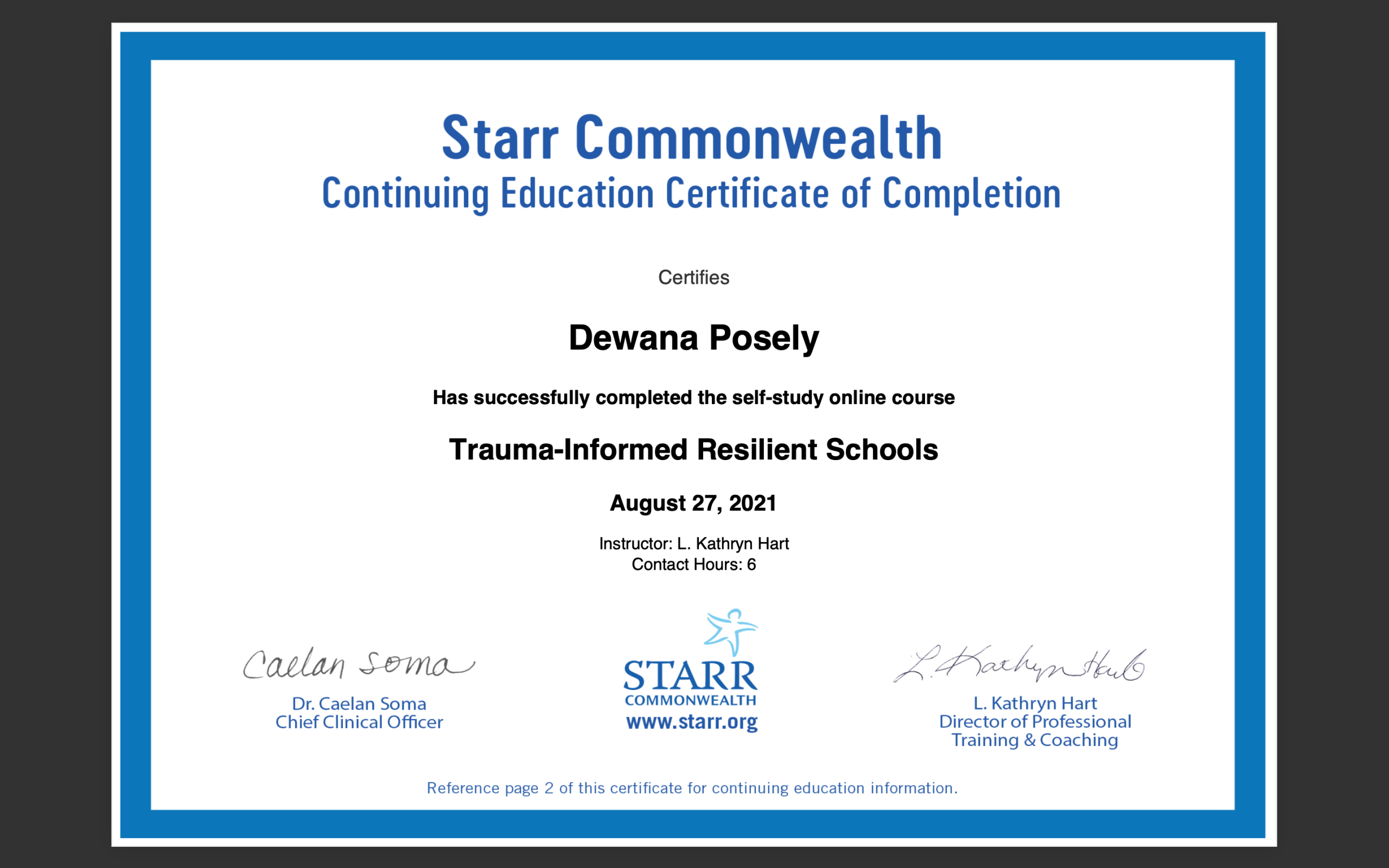
Through this training, I gained practical tools and strategies to help entire school systems recognize trauma-related behaviors as adaptive, and to promote positive relationships and co-regulation among staff and students. The training highlighted how sustainable change requires addressing schoolwide policies, practices, and professional mindsets—not just individual-level interventions.
My learning was grounded in the person-in-environment approach, which reinforced the understanding that students’ behaviors and emotional needs cannot be separated from the social, environmental, and systemic factors influencing them. This approach guided my perspective on how school climate, teacher responses, peer relationships, and external stressors (such as poverty or community violence) shape student development. It further affirmed the need for trauma-informed systems that respond holistically to students and families, rather than in separation.
One way I plan to apply this knowledge at the macro level is by advocating for and helping to implement schoolwide professional development on trauma-informed practices. This could include leading staff training sessions on restorative discipline, emotional safety, and culturally responsive classroom strategies. My goal is to influence institutional policies that plant emotional wellness and trauma-awareness into school culture—ensuring all students feel safe, supported, and empowered to succeed.
This experience enhanced my readiness to collaborate with school administrators, influence policy, and promote organizational change that reflects core social work values. It also deepened my ability to design evidence-based interventions that integrate the person-in-environment framework, promoting equitable outcomes for all members of the school community.
Field Evidence:During my practicum at the Bethlehem Center, I collaborated closely with my field instructor to design and implement Social-Emotional Learning (SEL) activities within the classroom environment. As part of this initiative, I developed detailed content outlines aligned with evidence-based SEL competencies and later created instructional videos to support teachers, parents, and students in applying these strategies consistently.
To strengthen my approach, I attended a series of professional development webinars hosted by the Collaborative for Academic, Social, and Emotional Learning (CASEL). These webinars provided practical, research-based tools for applying SEL in diverse educational settings. One session in particular, Integrating SEL to Connect, Heal, and Recover, emphasized the critical importance of addressing not only the physical safety of students and educators—but also their social, emotional, and environmental needs, especially in the wake of the COVID-19 pandemic.
This experience reinforced the relevance of the Person-in-Environment theoretical framework, which views individuals in the context of the multiple systems and environments that influence their behavior and well-being. In applying this framework, I recognized that promoting SEL cannot be done in isolation; it must take into account the relational, institutional, and environmental factors that affect students’ ability to regulate emotions, form healthy relationships, and engage in learning.
By using the person-in-environment as a guiding lens, I was able to design content that reflected the real-life experiences of the students we served—considering factors such as community stress, home-school dynamics, and classroom culture. The SEL resources I created were not only developmentally appropriate but also environmentally responsive, ensuring that both students and staff had tools to navigate emotional challenges within their broader social contexts.
This practicum experience and the professional development that supported it demonstrated how macro-level, evidence-based strategies can be implemented to support individual and community well-being. It also deepened my commitment to designing interventions that are not only effective but holistic, relational, and grounded in social work theory. The integration of the person-in-environment framework into my work allowed me to support resilience and healing across multiple levels of the educational ecosystem.