
For social workers, it is a priority to uphold ethical and professional values at the foundation of all decisions. Establishing healthy boundaries is an integral part of professional and ethical work and can be demonstrated in numerous ways. In the variety of roles that they may take on, social workers should seek to regulate personal and professional values appropriately. Professionalism is made up of many seemingly small choices and is communicated in the way one presents him or herself, which may include behaviors, clothing choices, punctuality, and communication. Keeping personal space neat and being considerate of coworkers also communicates professionalism. In a practice setting, technology should be used to the further work done on behalf of those being served. Social workers should take the initiative to grow professionally by seeking consultation and applying critical thinking continued education. By proactively establishing healthy boundaries, the safety of social workers and their clients will be increased by protecting professional, ethical, and personal values.

1A – Develop a practice framework for analysis of complex environments, that is ethical, value-grounded, and evidenced-based.
While completing my practicum at Parkridge Valley Child & Adolescent, I sought to begin developing a practice framework. In order to do this, I began reviewing evidence-based social worker models and theories. I chose three that I felt were most relevant to the practice setting I was in and summarized them. I then wrote about the main advantages and limitations to applying them to the specific work environment in this Practice Framework Report. In completing this, I focused on the following theoretical foundations: Problem Solving Model, Task-Centered Practice, and Cognitive Behavioral Therapy.
1B – Implement supervisory and self-care strategies that integrate professional strengths, limitations, and challenges.
While in the MSW Program, I attended a book club where we read a book entitled How People Grow, by Henry Cloud and John Townsend. Written by Christian psychologists, the book delves into the process of growth from a Christian perspective. The book is written for those seeking to grow as well as those seeking to help others grow. By reading and attending this book club, I practiced self care in a way that fostered professional strengths and brought to light areas where I need further growth. Meeting with others reading the same material challenged me to go deeper in my understanding and to be accountable in my application.

As a part of my field experience, I traveled to Fletcher Academy to provide guidance and answer questions for high-school students who have an interest in pursuing a career in social work. I presented to an audience regarding social work and provided supervision in a way that required my professional strengths. I engaged with students intentionally and quickly built rapport in an effort to be helpful to them. I sought to first connect with them and understand what they had on their minds before sharing the information that I had available for them. In this way, I could better determine what to share. I provided information on social work as a profession, academic information, and contact information to empower students to make decisions and take steps towards future education and careers. In completing this, I had to utilize several skills, including active listening, communicating, and presenting in order to educate and guide students who are determining future career paths.I also utilized knowledge of social work as a profession as well as my knowledge of the School of Social Work at Southern.

1C – Exhibit commitment to professional growth through continuing education, supervision, and ongoing consultation.
As a part of the Advanced Program Development class, I completed a training on conducting research in an ethical and responsible way through the Collaborative Institutional Training Initiative. The training covered many different aspects of conducting research, which have already been applicable. Completing this training not only demonstrated my current commitment to learning, but it also shows that I am committed to continually learning through research as I continue in my journey as a social worker. The value of competence is present within this practice behavior since continuing to position myself as learner will increase my knowledge and skills regarding my work with clients.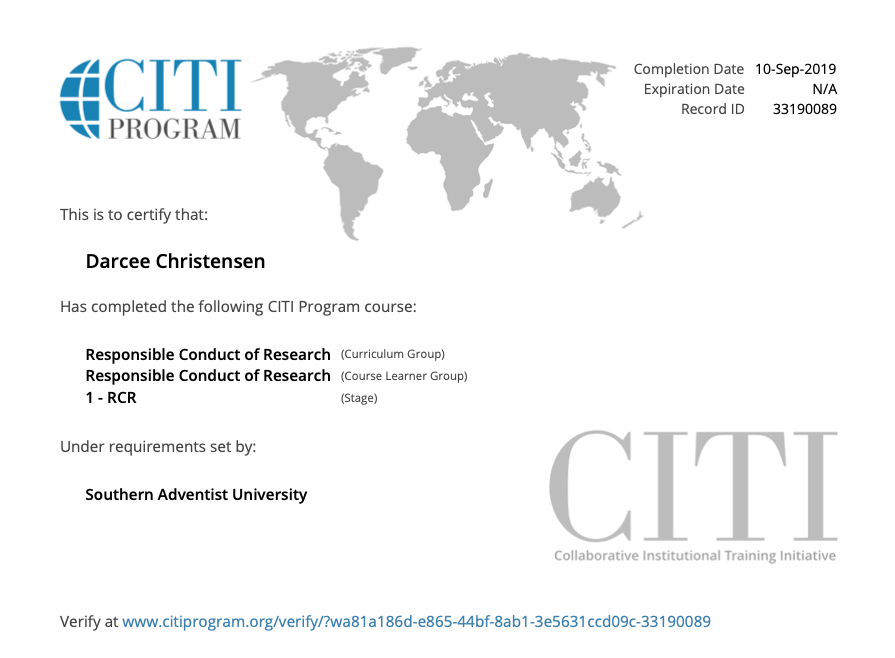
1D – Demonstrate professional oral and written communication skills
I demonstrated professional written and oral communication in my course work as well as in my field experience. One example of this can be found in the final video that I recorded for Advanced Clinical Practice. In this video, I practice Cognitive Behavioral Therapy with a pseudo client. I conduct myself professionally in the way that I act and speak throughout the video. I demonstrated professional written communication through rewriting portions of this interview in my CBT Reflection Paper to further improve my choice of words. On the affective domain, I am on the level of valuing since I am committed to integrating professionalism in written and oral communication. I am still working towards developing this towards characterization. In terms of cognition, I believe that I am on the creating level when it comes to professional communication because I am able to generate professional communication.
