Introduction
While interning at the American Red Cross in Southeast Tennessee Chapter, I had the opportunity to develop a pilot program that would expand the Comfort Kit to ensure that the needs of the clients who experienced a disaster were being met. The pilot program expansion was called “Recovery Kit.” This project allowed me to work with Dr. Laura Racovita, my advisor; Idaline Diaz, Disaster Program Manager; Regina Orma, Disaster Program Specialist; Lori Lester, my field instructor; Disaster Cycle Services volunteer members, community members, and Revive, a small church group for adults with disabilities.
Social Issue
Social injustices are occurring more frequently due to more disasters becoming an issue due to climate change (U.S. Geological Survey, n.d.). Environmental, socioeconomic, and racial inequality are social justice issues that affect how unprepared a person may be. A study by the Federal Emergency Management Agency in 2023 found that only 57% of adults prepared by taking three or more actions, with 50% of people believing that preparing for disaster would help. Within those actions, 37% had an emergency plan, 30% safeguarded their essential documents, 30% documented and insured property, and 50% assembled supplies. The Recovery Kit helps alleviate the injustices people are dealing with while recovering from a disaster.
The environmental and social justice issue is being seen in our area. In the Southeast Tennessee Region of the American Red Cross, which encompasses 14 counties, 145 disaster incidents were responded to by the American Red Cross from January 2024 until June 2024. People who face disaster do not always have time to grab everything needed (American Red Cross, 2022). The average time that someone has to escape from a fire is two minutes or less (American Red Cross, 2022). Storm storms can cause massive damage and tornadoes that will hit unexpectedly, causing people not to be prepared (Substance Abuse and Mental Health Services Administration, 2023). The unexpectedness of the disaster causes a crisis for the people involved. The trauma leaves the affected people unsure of their next steps and how to cope with the loss (Morganstein & Ursano, 2020).
Low socioeconomic status also affects how well a person can recover from a disaster (Substance Abuse and Mental Health Services Administration, 2017). With socioeconomically disadvantaged adults, 41% assembled supplies, 22% safeguarded their documents, and 21% documented and insured their property (Federal Emergency Management Agency, 2023). Not only are they not prepared, but they tend to live in homes that are not adequate to withstand a disaster, do not have the financial resources to recover, and have a difficult time navigating how to find resources (Substance Abuse and Mental Health Services Administration, 2017).
Racial and ethnic inequality affect how well people are prepared for a disaster (Fathergill et al., 1999). The Federal Emergency Management Agency survey in 2023 shares that 43% of African Americans and 52% of Hispanics have assembled supplies, 28% of African Americans and 34% of Hispanics have documented and insured property, 22% of African Americans and 32% of have safeguarded their documents, and 42% of African Americans and 43% of Hispanics made a plan. Not only that, but it also affects how well they mentally recover (Fathergill et al., 1999). African Americans and Hispanic adults tend to report more feelings of helplessness, stress, and hopelessness than Whites.
Goals
This project gives the clients the tools and resources needed to aid their recovery. The coping skills sheet and stress symptoms will help the client understand how the disaster has affected them and their families and allow them to see that what they are experiencing is common. The materials will aid in their self-care and decrease the effects of the disaster by giving them coping skills while, at the same time, helping them realize when to seek mental health help. Vital document information and tools will enable the client to know their next steps since they will be experiencing brain fog, distractibility, or difficulty making decisions (Cleveland Clinic, 2024). Put together, the Recovery Kit will help them recover faster and decrease their stress while increasing their resiliency.
Intervention Options
The environmental crisis is increasing exponentially, causing devasting effects on people facing socio-economic, cultural, and political injustices (Papadimitriou et al., 2021). Currently, the intervention options for clients are that they have prepared for a disaster or rely on an organization to provide during the recovery phase of a disaster. However, clients often do not know the information needed, do not have items available, or do not get the information early on in the disaster (Han & Wu, 2024). This type of intervention translates into social injustice. Using green social work (GSW) to understand how environmental, social, and political injustices affect a person’s well-being during a natural disaster (Breen et al., 2023) and the National Disaster Recovery Framework, this project will help alleviate the injustices that happen during a disaster (Department of Homeland Security, n.d.; Murray et al., 2021).
The solution to alleviate these injustices would be to provide tools and resources to help give self and community efficacy and coping skills to aid in their recovery efforts. The Recovery Kit aims to provide environmental and social justice to clients.
Recovery Kit
I was the project manager for this pilot program and collaborated with many different people in the Southeast Tennessee American Red Cross. The Disaster Program Manager (DPM) and Disaster Program Specialist (DPS) brought the pilot program to my attention due to their years of experience working with disaster survivors. They saw a need for expanding the Comfort Kits to provide more than hygiene items to people affected by disasters. I was asked to carry out this proposed pilot program.
I first conducted a literature review to find out more about why this is a problem and what the current intervention is. After conducting the research, I created a Logic Model for the pilot program that defined the Red Cross, and I was being invested in (inputs), what activities/resources were needed (outputs), and what the projected impact (outcomes) was. I then completed a Needs Assessment with the help of Disaster Action Team (DAT) responders and DAT Recovery care workers. These groups contributed valuable information from their interactions with clients after the disaster. The information gathered from the literature review and needs assessment showed that the proposed pilot program would benefit the clients. Survey Responses
After consulting with the DPM and my field instructor, I asked community members and small groups to donate supplies. I wanted to ensure I would get everything, so I made an Amazon Wishlist with the exact items and quantities needed. This list on Amazon made it easier for people to purchase what fits their budget. I had 25 people donate the needed items.
I also knew that I would need help assembling the recovery kits, so I contacted Revive. Revive is a small group of adults with disabilities that get together at Silverdale Baptist Church. This group loves volunteering, and I thought it would be a great way to introduce them to volunteering at the American Red Cross. Before assembling, I talked to the Revive group about disaster preparedness. We went over information on how disasters affect us and why we were assembling the kits. Afterward, Revive assembled 60 kits.
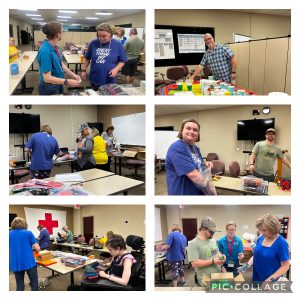
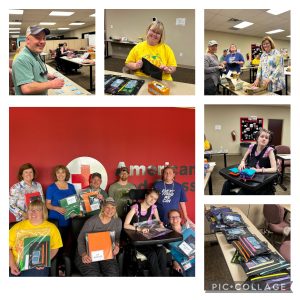
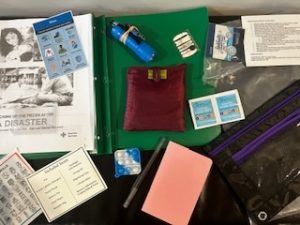
After assembling the kits, I presented them at the August 1, 2024, DAT meeting. I went over the mental health needs of our clients after a disaster and why each item in the kit was essential. I also gave instructions on how they could access the kits and how they were to give them away. Giving this information will help the DAT responders understand the process of obtaining the Recovery Kit, its importance, and a description of each item.
Results
There are no results since the Recovery Kits have not yet been implemented. American Red Cross has experienced more disasters in the last few months, operating in gray sky rather than blue sky. When operating in gray sky, only the essential functions exist. The DPM anticipates that the Recovery Kit will be handed out to DAT responders by September 1. The DPM has all the materials needed to continue the program after the 60 Recovery Kits are given away.
Evaluation Tool
The DPM and DPS will complete a process evaluation using a Responders Satisfaction Survey to determine if the Recovery Kit is successful and needs to be turned into an entire program. It will also include monitoring case notes on questions (Questions for clients) that the Disaster Recovery Care Workers asks the client to evaluate that the program’s goal is being met.
Conclusions
Limitations
There are a couple of limitations to this pilot program. This program may be stopped if the American Red Cross decides they do not want to continue after the pilot program ends. Secondly, suppose the American Red Cross decides not to be financially responsible for the program. In that case, there may not be any organization that will provide the recovery kit items needed for Southeast Tennessee American Red Cross clients during a disaster if the American Red Cross.
Changes
There are a couple of changes that I would have made. One is that I limited the scope of asking for donations from the community, not wanting to set the pilot program up for failure. While the DPM had asked for 40 Recovery Kits to be assembled, I asked for enough supplies for 60. However, I underestimated the community’s generosity and willingness to donate. I think I could have more materials donated, leading to more Recovery Kits assembled. Secondly, I would have included DAT members in assembling the Recovery Kits. Having more people while assembling the kits would overwhelm the Revive group, so I had no other people there. I now know I should have included Revive in the discussion and let them decide.
Competencies
Competency One: Demonstrate Ethical and Professional Behavior
Professional writing skills, oral skills, and appearance were used when contacting community members to donate and asking for volunteers to assemble the kits. Also, I connected regularly with my field supervisor to discuss the project and if there needed to be changes made. I also practiced self-care during this time to help avoid burnout.
Competency Two: Advance Human Rights and Social, Racial, Economic, and Environmental Justice
This evidence-based project addresses the environmental, social, racial, and economic injustices people face during a disaster. The Recovery Kit will distribute needed supplies free of charge, equitable, and remain culturally relevant.
Competency Three: Engage in Anti-Racism, Diversity, Equity, and Inclusion in Practice
The Recovery Kit implemented evidence-based practices to ensure that the project remains inclusive to all clients regardless of their social, racial, economic, and cultural backgrounds. Providing the recovery kit materials in Spanish and low literacy will make the project more inclusive to clients. Adults with disabilities assembled the kits, ensuring they knew their worth.
Vital Documents and Whom to Contact About
Stress Signs and Symptoms for Recovery Kit
Competency Four: Engage in Practice-Informed Research and Research Informed Practice
Research was completed on the most culturally informed, anti-racist, ethical, and anti-oppressive evidence-based practice for the project planning and implementation. I completed a literature review on A needs assessment was completed, along with a logic model.
Competency Five: Engage in Policy Practice
I advocated for a policy change to ensure people have the tools and resources to aid their recovery by sharing my research with the DPM and the DPS. Since the Recovery Kit is a pilot program, I shared with leadership all relevant information and materials so that the American Red Cross can continue to use the program after the internship.
Competency Six: Engage with Individuals, Families, Groups, Organizations, and Communities
I engaged with individuals, organizations, and communities was initiated using person-in-environment, empathy, and active listening skills. Interprofessional partnerships will be utilized while engaging stakeholders, allowing the DAT responders to buy in with the pilot program. Discussions with community members and organizations lead to donations of needed items and the assembly of recovery kits.
Competency Seven: Assess with Individuals, Families, Groups, Organizations, and Communities
I completed a needs assessment before planning for the materials needed for the kit. The American Red Cross will use its intake and disaster categories to ensure clients receive the recovery kit.
Competency Eight: Intervene with Individuals, Families, Groups, Organizations, and Communities
This intervention is an evidence-based disaster response. The Recovery Kit provides the needed tools and resources to clients, which will aid in their recovery efforts after a disaster.
Competency Nine: Evaluate with Individuals, Families, Groups, Organizations, and Communities
DAT Responders and clients will complete a satisfaction survey to gauge the response to the Recovery Kits. DAT Recovery care workers’ case notes from client interactions concerning the kit will help evaluate the project to ensure it meets the goals.
Responders Satisfaction Survey
Memo for DAT Recovery care workers
References:
American Red Cross. (2022, October 6). Two Minutes may be all you have to escape a home fire – the nation’s most frequent disaster. Press Release. https://www.redcross.org/about-us/news-and-events/press-release/2022/two-minutes-may-be-all-you-have-to-escape-a-home-fire.html
Breen, K., Greig, M., & Wu, H. (2023). Learning green social work in global disaster contexts: A case study approach. Social Sciences, 12(5), 288. https://doi.org/10.3390/socsci12050288
Cleveland Clinic. (2024, May 15). What is stress?. Stress. https://my.clevelandclinic.org/health/diseases/11874-stress
Department of Homeland Security. (n.d.). National disaster recovery framework, second edition. FEMA. https://www.fema.gov/sites/default/files/2020-06/national_disaster_recovery_framework_2nd.pdf
Federal Emergency Management Agency. (2023). 2023 national household survey on disaster preparedness. Preparedness Community. https://fema-community-files.s3.amazonaws.com/2023-National-Household-Survey.pdf
Fothergill, A., Maestas, E. G., & Darlington, J. D. (1999). Race, ethnicity and disasters in the United States: A review of the literature. Disasters, 23(2), 156–173. https://doi.org/10.1111/1467-7717.00111
Han, Z., & Wu, G. (2024). Why do people not prepare for disasters? A national survey from China. Npj Natural Hazards, 1(1). https://doi.org/10.1038/s44304-024-00001-2
Morganstein, J. C., & Ursano, R. J. (2020). Ecological disasters and mental health: Causes, consequences, and interventions. Frontiers in Psychiatry, 11. https://doi.org/10.3389/fpsyt.2020.00001
Murray, V., Clarke, L., & Maini, R. (2018). Disasters, health impacts and the value of implementing the Sendai Framework for Disaster Risk Reduction 2015–2030. The Routledge Handbook of Green Social Work, 35–47. https://doi.org/10.4324/9781315183213-4
Papadimitriou, E., Ευριπίδης, & Πανεπιστήµιο. (2021a). Defining green social work. Social Cohesion and Development, 15(1), 139–152. https://www.researchgate.net/publication/349733591_Defining_Green_Social_Work
Substance Abuse and Mental Health Services Administration. (2017, July). How disasters affect people of low socioeconomic status. Disaster Technical Assistance Center Supplemental Research Bulletin. https://www.samhsa.gov/sites/default/files/dtac/srb-low-ses_2.pdf
Substance Abuse and Mental Health Services Administration. (2023, June 9). Tornadoes and severe storms. Types of Disasters. https://www.samhsa.gov/find-help/disaster-distress-helpline/disaster-types/tornadoes
U.S. Geological Survey. (n.d.). How can climate change affect natural disasters?. Climate. https://www.usgs.gov/faqs/how-can-climate-change-affect-natural-disasters